An Open-Weight Model Just Cracked the Top 3 of the WebDev Coding Leaderboard
Kimi K3 is the first open-weight model in the top 3 of Arena's WebDev board, as Opus 5 takes #1 and Grok 4.6 undercuts everyone on price.
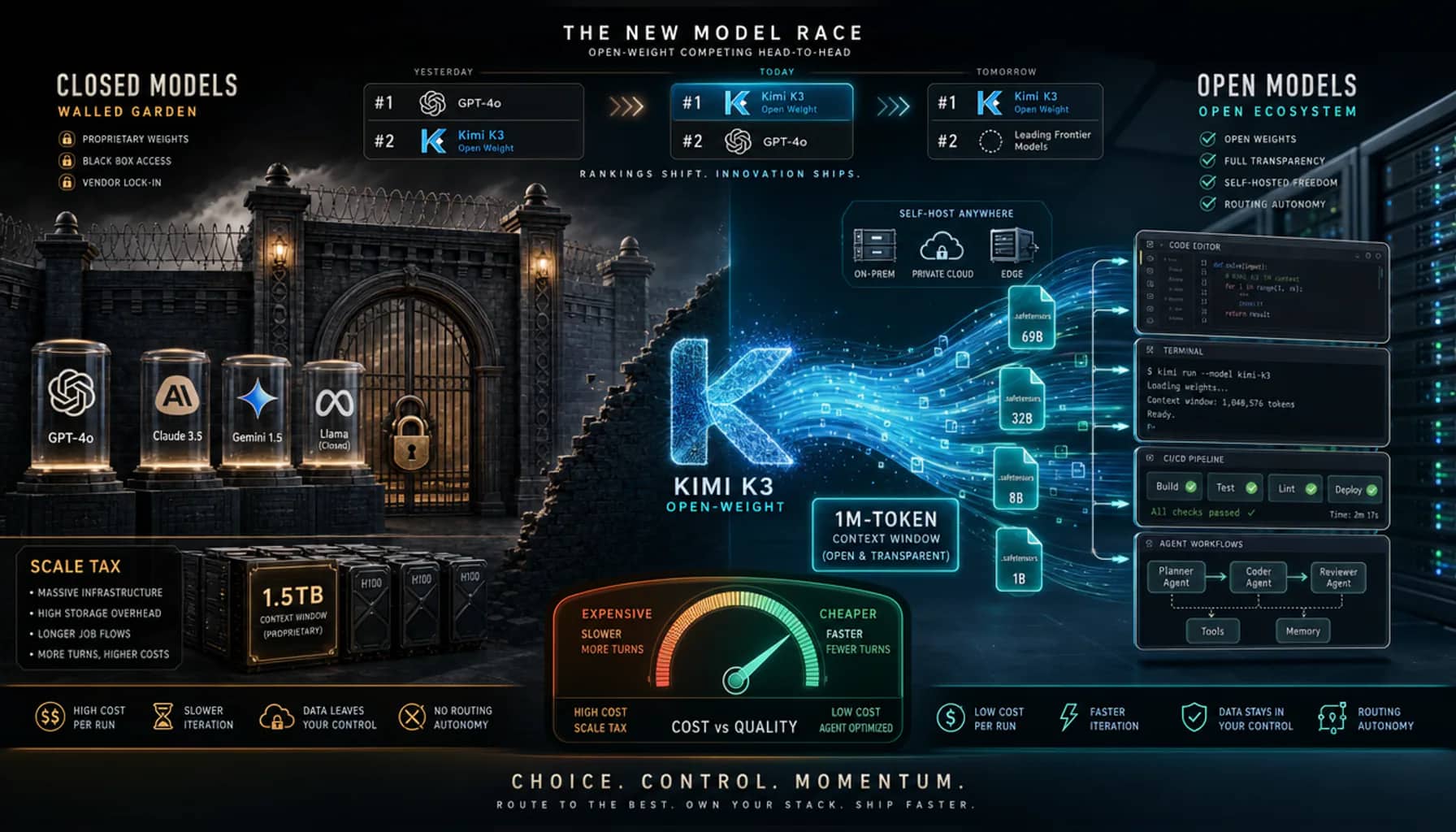
For most of the past two years, the top of the AI coding leaderboards was a closed race between a few proprietary labs. That changed this month. On Arena's WebDev leaderboard, the model that just broke into the top three ships its weights.
Kimi K3, from Moonshot AI, now sits around #2 on WebDev, the first open-weight model to crack the top three there. Above it is Claude Opus 5, which took #1 and pushed the previous leader, Fable 5, to #4. Grok 4.6 rounds out the debut wave. (Exact Elo shifts by snapshot and the newest models are still gathering votes, so treat the point spreads as approximate and check the live board for the current order.)
What an open-weight #2 signals
A proprietary model topping a benchmark is routine; an open-weight one reaching #2 is not. Kimi K3 is reported as a 2.8-trillion-parameter model with native vision and a 1M-token context, and because its weights are downloadable, teams can in principle self-host, fine-tune, or audit it in ways a closed API never allows. The strategic signal is the real news: on this board, the gap between the best closed model and the best open one is now points, not generations.
The catch is scale. "Open weight" doesn't mean "runs on your laptop": self-hosting Kimi K3 reportedly means moving on the order of 1.5 TB of weights plus the GPUs to serve them. For most teams the realistic path stays a hosted endpoint, or a smaller local model. If you want to run one yourself, our guide to local LLMs on a Mac is a gentler starting point than a trillion-parameter download.
The other story is price
Grok 4.6's headline isn't the ranking, it's the bill. xAI is reported to price it far below Opus 5, and independent testing has it finishing long agentic jobs in fewer turns while scoring in the high 80s on Terminal-Bench. For anyone running agents at volume, "most of the quality at a fraction of the price" is a trade many workloads will take.
What to do with this
Churn this fast is a reason to stop hard-coding one model. Two moves follow. Benchmark the cheap tier against your tasks, not the public board; the #3 model overall may be #1 for your codegen or extraction workload at a fraction of the cost. And keep model choice swappable behind a thin abstraction, because the winner of your cost-per-quality math today won't be next quarter's. The frontier is no longer a two-lab club; the leverage is shifting from "who has the best model" to "who routes work to the right one." As those routed jobs get more autonomous, the industry is scrambling to track when agents misbehave, too. Check arena.ai for live ranks before quoting exact numbers.
Join the discussion on An Open-Weight Model Just Cracked the Top 3 of the WebDev Coding Leaderboard
Likes, comments, and replies are available for authenticated readers with verified email addresses.
Comments (0)
Loading discussion...More news

Claude Code's Weekly Limits Go Up 25% and Down 17% on September 14
Both of Anthropic's numbers are correct. Which one you feel depends on your baseline. Here is the arithmetic, and what to change before the 14th.

GitHub's HydraFusion Beats Claude Opus 5 on One Benchmark of Three
HydraFusion landed in Copilot CLI on September 4 as a research preview. The headline is frontier quality. The benchmark table says the real story is cost.

September 2026 Patch Tuesday: The Dev-Machine CVEs Windows Update Won't Fix
Two GitHub Copilot and VS Code flaws, an MSAL for Node.js bug, and an Azure CLI RCE all landed on September 8. None of them are fixed by Windows Update.